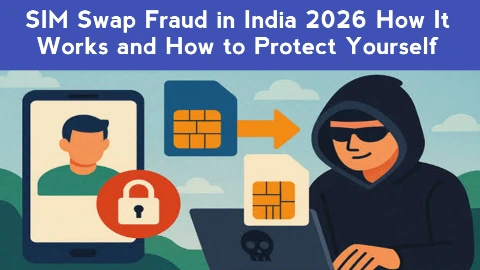
SIM swap fraud has become one of the most dangerous cyber crimes in India in 2026. Unlike normal scams where fraudsters trick people into sending money directly, SIM swap fraud allows criminals to secretly take control of a victim’s mobile number and access bank accounts, UPI apps, emails, and social media profiles.
The scary part is that many victims do not even realize they are being attacked until their bank balance suddenly disappears.
As India becomes increasingly dependent on OTP based verification systems, mobile numbers now act like digital identity keys for banking, UPI payments, and online services.
Hackers know this very well.
Instead of attacking bank servers directly, fraudsters now target the weakest point in the system which is mobile number control.
In this detailed guide, we will explain what SIM swap fraud is, how scammers perform it, warning signs, real risks, and the best ways to protect yourself in 2026.
What is SIM Swap Fraud?
SIM swap fraud is a cybercrime where scammers transfer your mobile number to a SIM card controlled by them.
Once they gain access to your number, they start receiving:
- Bank OTPs
- UPI verification codes
- Password reset links
- Call verifications
- Login alerts
This allows criminals to access banking apps, social media accounts, email accounts, and digital wallets connected to your phone number.
In many cases, victims lose money within minutes.
How SIM Swap Fraud Works
SIM swap attacks usually happen in multiple stages.
Step 1. Personal Information Collection:
Scammers first collect personal details using phishing links, fake customer care calls, social media information, leaked databases, or fake KYC verification tricks.
Commonly stolen details include:
- Mobile number
- Date of birth
- Aadhaar details
- PAN information
- Bank details
Step 2. Fake SIM Replacement Request:
The fraudster contacts the telecom company or visits a retailer pretending to be the victim.
They claim the SIM card was lost, damaged, or not working.
Using fake documents or social engineering tricks, they request a duplicate SIM card.
Step 3. Original SIM Stops Working:
Once the telecom provider activates the duplicate SIM, the victim’s original SIM suddenly loses network connection.
This is often the first warning sign.
Many people mistakenly think it is only a temporary network problem.
Step 4. Account Takeover:
The fraudster now receives all OTPs and verification messages.
They quickly reset passwords and access:
- UPI apps
- Bank accounts
- Email accounts
- Social media accounts
- Digital wallets
Money is then transferred rapidly before the victim realizes what happened.
Why SIM Swap Fraud is Growing in India
India’s digital payment ecosystem is growing extremely fast.
UPI, OTP banking, mobile wallets, and Aadhaar linked services have made mobile numbers central to financial security.
Cyber criminals target this weakness because controlling a mobile number often gives access to multiple connected accounts.
Another reason is the rise of social engineering scams where fraudsters manipulate telecom support staff or use fake identity documents.
Common Warning Signs of SIM Swap Fraud
Recognizing early warning signs can save your bank account.
- Sudden loss of mobile network
- No incoming calls or SMS
- Unknown SIM activation alerts
- Bank login notifications you did not request
- UPI app logout messages
- Password reset alerts
If your SIM suddenly stops working without reason, never ignore it.
How Hackers Use SIM Swap for UPI Fraud
UPI apps rely heavily on mobile number verification and OTP systems.
Once scammers gain control of your SIM, they may:
- Reset UPI app access
- Approve banking logins
- Receive OTP verification codes
- Create new device registrations
- Transfer money instantly
Because UPI transactions happen very quickly, victims often discover the fraud too late.
Real Risks of SIM Swap Fraud
SIM swap attacks can cause much more damage than simple financial loss.
- Bank account theft
- Identity theft
- Email hacking
- Social media takeover
- Loan fraud using stolen identity
- Blackmail and extortion
Some victims also face long legal and banking disputes after the attack.
How to Protect Yourself from SIM Swap Fraud
1. Never Share OTPs:
No bank or telecom company will ever ask for OTPs over calls or messages.
2. Add SIM Lock or Telecom PIN:
Many telecom providers now offer additional SIM security PIN features.
This makes unauthorized SIM replacement harder.
3. Use Strong Banking Security:
- Enable biometric login
- Use app locks
- Enable email alerts
- Use strong passwords
4. Avoid Suspicious Links:
Many SIM swap attacks start through phishing websites and fake KYC verification messages.
5. Immediately React to Network Loss:
If your SIM suddenly loses signal unexpectedly:
- Contact your telecom provider immediately
- Block banking access temporarily
- Check for suspicious activity
- Inform your bank quickly
6. Limit Personal Information Sharing:
Fraudsters often collect personal information from social media and leaked databases.
Avoid publicly sharing sensitive personal details online.
What to Do if You Become a Victim
If you suspect SIM swap fraud, immediate action is critical.
- Call your telecom provider instantly
- Block your SIM temporarily
- Contact your bank immediately
- Freeze UPI services
- Change important passwords
- Call cybercrime helpline 1930
- File complaint on cybercrime portal
Quick reporting can help stop fraudulent transactions before more damage happens.
Are Telecom Companies Improving Security?
Telecom providers and regulators in India are introducing stricter KYC checks, delayed SMS activation after SIM replacement, and additional verification systems.
However, cyber criminals continue adapting their methods.
This is why user awareness remains one of the strongest defenses.
Final Words:
SIM swap fraud is one of the most dangerous digital banking threats in India in 2026 because it attacks the foundation of modern online verification systems.
Most people trust their mobile number completely, but hackers now understand that controlling the number often means controlling the entire digital identity.
The good news is that most SIM swap attacks can still be prevented through awareness, fast response, and better security habits.
Always treat sudden SIM failure seriously, protect personal information carefully, and never trust unknown calls asking for OTPs or KYC verification.
In today’s digital world, protecting your mobile number is just as important as protecting your bank account.